





Written by Rissa Hanneken, former 3rd-5th grade teacher, instructional coach, and new teacher mentor with 19 years of experience in Florida classrooms, and the creator of Teaching in the Heart of Florida. Rissa creates no-prep reading, math, and emergency sub plan resources for upper elementary teachers, built on real classroom experience. Her resources are purposeful, manageable, and ready when you need them most.
For a long time, I avoided reading escape rooms completely.
I loved the idea. My students were bored with the same review activities, and I kept seeing other teachers post about escape rooms on Instagram. They sounded amazing. Still, every time I seriously thought about doing one, I chickened out.
The directions looked overwhelming—locks, keys, backstories, and props—all to be pulled together during a very short planning period.
So I kept putting it off, and as a result, I left the classroom before I ever actually tried one.
But as escape rooms grew, I couldn’t stop thinking about my upper elementary students and how much they would have loved something like that. However, the more I looked at what was out there, the more wary I got: too many steps, too much prep, and activities unrelated to actual student learning. These were fun in theory, but lacked the skills practice that teachers actually need.
So I started creating my own. Reading escape rooms that were genuinely fun for students and built from the ground up around real reading skills.
And the teachers who use them in their classrooms? They keep coming back for more.
If you have been curious about reading escape rooms but had no idea where to start, you are in the right place. In this post, I will show you how reading escape rooms can make reading more interesting for your students, explain exactly what a reading escape room is, how to run one in your elementary classroom, and how to make it work even on your busiest weeks. No props required.
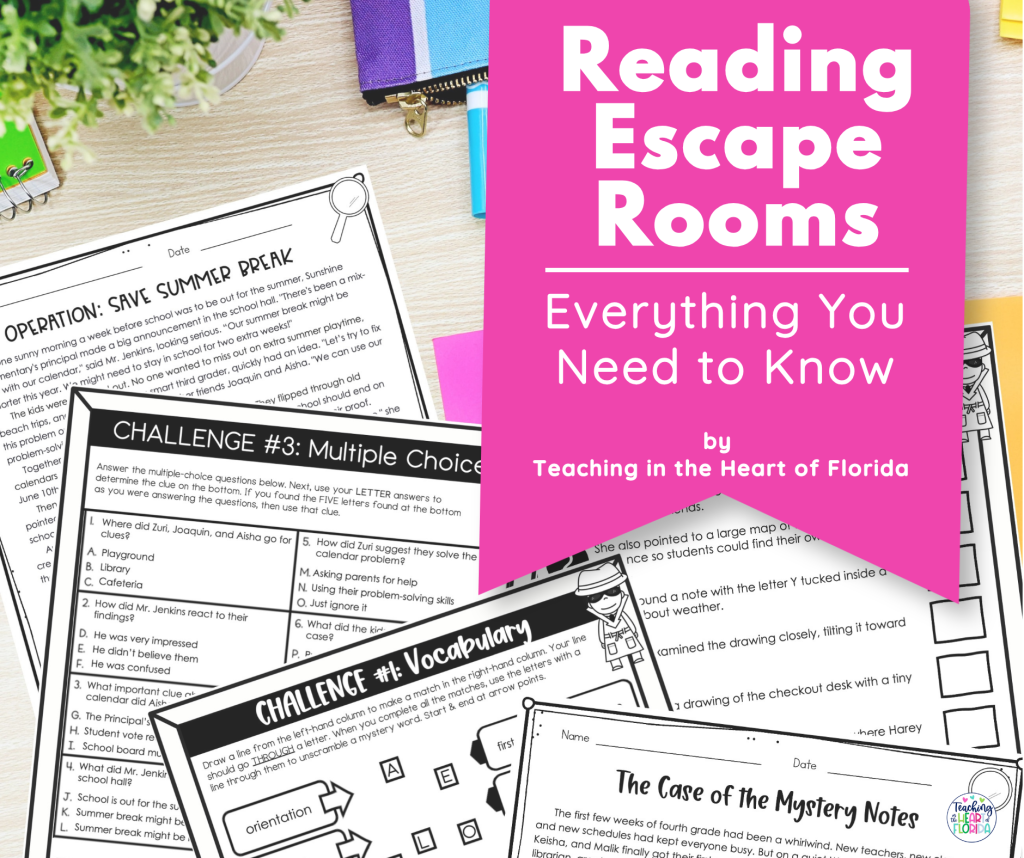
Table of Contents
How Do Reading Escape Rooms Work?
Here is the short version: students read a passage, complete four skill-based challenges, collect a number from each one, and use those four numbers to crack the escape code. That is it. No locks, no keys, no running around the classroom. Just print, hand it out, and let them get to work.
But here is what makes these reading escape rooms different from others you might have seen. Every single challenge comes from the same reading passage. Students are not just playing a game. They are reading and re-reading that passage multiple times as they work through each task, which is exactly what close reading practice looks like.
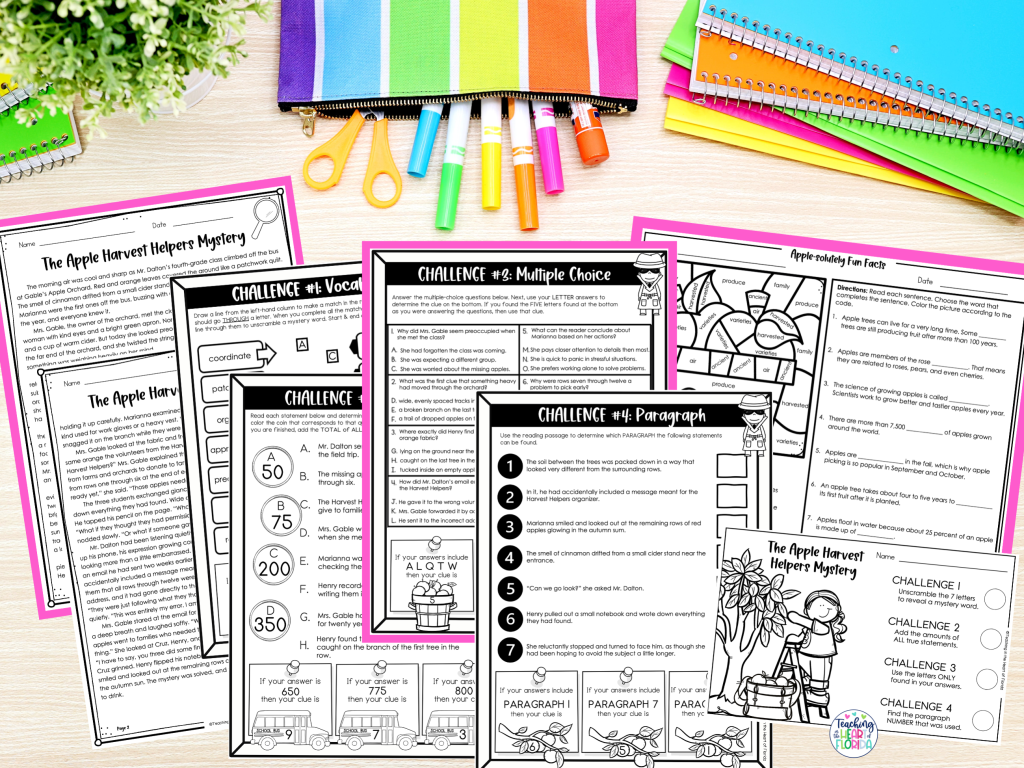
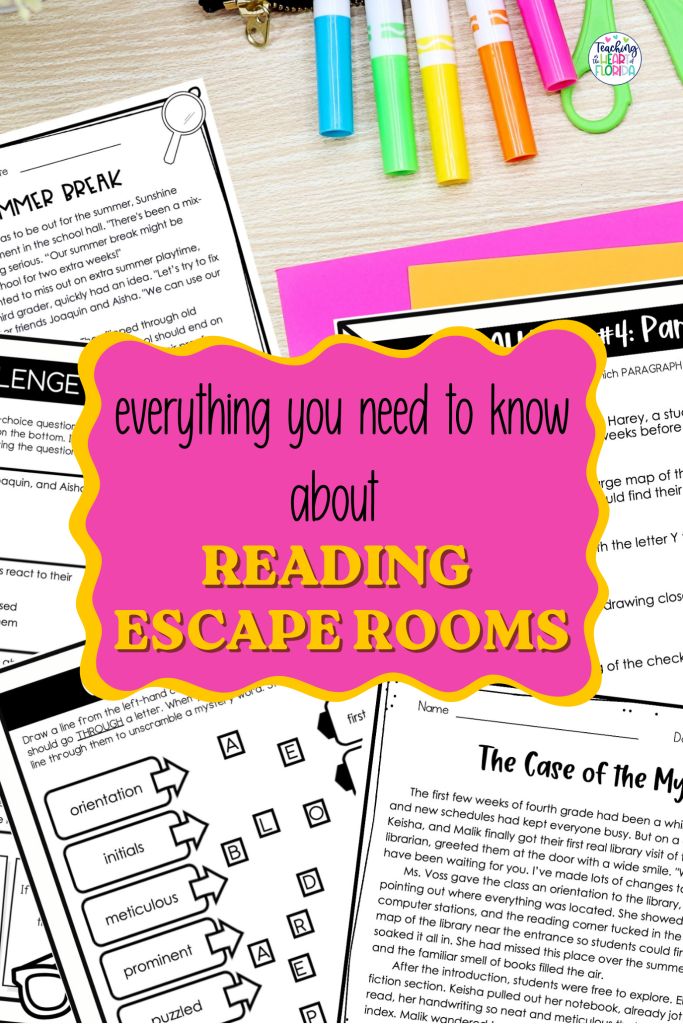
In the first challenge, students match vocabulary words to definitions by drawing lines through letter boxes. The path they draw reveals scrambled letters, and when they unscramble those letters they get the first number in their escape code.
In the second challenge, students read a series of statements and decide if each one is true or false based on the passage. They add up the values of the true statements to get their second number.
In the third challenge, students answer multiple choice comprehension questions. Their letter answers point them to the third number.
In the fourth challenge, students identify which paragraph in the passage each statement can be found in, which gives them the fourth number.
Four challenges. Four numbers. One escape code.
When students crack the code, they get to complete a fun color by number activity as their prize. It is a nice way to end the activity and gives early finishers something to do while other groups are still working.
The whole thing works well for small groups or the whole class. As for timing, it really depends on your students. Strong readers can often get through it in one class period, while others may need a little more time. It is a flexible activity that way.
What Reading Skills Do These Reading Escape Rooms Cover?
This is the part that matters most to me as a creator, and honestly it is what sets these reading escape rooms apart from a lot of what is out there.
Every challenge is built around a real reading skill. Not busy work. Not filler. Actual skills that upper elementary students need to practice regularly.
The vocabulary challenge asks students to match words to definitions using context from the passage. This is not a standalone vocabulary worksheet. Students have to go back into the text to make sense of the words, which is exactly the kind of contextual vocabulary practice that sticks.
The true and false challenge targets reading comprehension and text accuracy. Students have to read each statement carefully, go back to the passage to verify it, and decide whether it holds up. This builds the habit of checking the text rather than going with a gut feeling.
The multiple choice challenge covers comprehension questions tied directly to story details and events. Students who are tempted to guess quickly will find that the answer choices are close enough to require them to actually read carefully.
The paragraph challenge is one of my favorites because it targets a skill that does not get enough practice: locating information within a text. Students have to identify exactly which paragraph a statement came from, which pushes them to read with purpose and pay attention to how a passage is organized.
Put all four challenges together and you have vocabulary, comprehension, text verification, and text structure all in one activity. That is a lot of skill practice wrapped inside something that feels like a game.
Who Are These Reading Escape Rooms Designed For?
My reading escape rooms are designed for upper elementary students, specifically grades 3 – 5. The reading passages are written at a level that challenges students without being so difficult that they shut down before they even get to the fun part.

That said, you know your students better than anyone. A strong third grade class might fly through one of these, while a struggling fifth grade group might need a little extra support or an extra day to finish. The activity is built to work across a range of readiness levels because the passage and the challenges are the same for everyone. What changes is how long it takes and how much support individual students need along the way.
In terms of classroom setup, reading escape rooms work well in a few different situations. Small groups are a natural fit because students can talk through the challenges together and hold each other accountable. But they also work for whole class instruction, where every group works through the same escape room at the same time. Some teachers have even used them as an early finisher activity or as a structured option for a sub day, since the directions are clear enough for students to work through mostly independently.
As for time of year, there is really no wrong answer. I have designed reading escape rooms around different themes so you can find one that fits the season or the moment. Back to School, Halloween, spring, and more. If you want to see the full list of available themes and grade levels, you can browse them all in my Teachers Pay Teachers store.
Reading Escape Rooms You Can Use This Week
I know it is one thing to read about how these work and another thing to actually see one. So let me show you a real example.
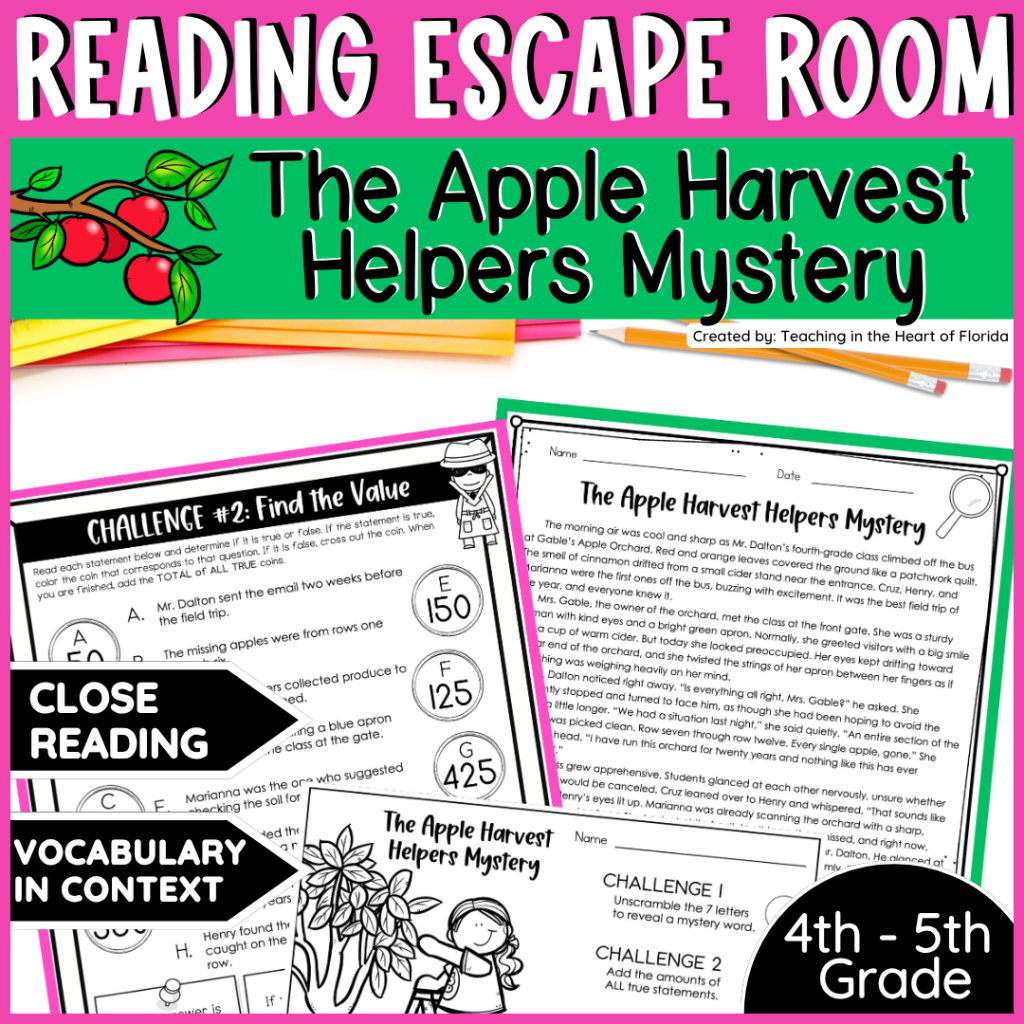
The Apple Harvest Helpers Mystery is a reading escape room designed for 4th-5th-grade. Students read a passage about a field trip to an apple orchard where they help solve a mystery, then work through four challenges to crack the escape code. The passage is close to 950 words and has a reading level of around 4.74 (Flesch-Kincaid), which puts it right in the sweet spot for upper elementary readers.
The storyline is engaging enough to pull students in right away, and the four challenges cover vocabulary, comprehension, text verification, and paragraph identification. By the time students crack the code, they have read that passage more times than they probably realize. That is the whole point.
If The Apple Harvest Helpers Mystery sounds like something your students would love, you can grab it right here.
If you want to browse the full collection of reading escape rooms for grades 3 through 5, including seasonal themes and more, you can find everything in my shop here.
Built for Real Classrooms: What Happens After the Code is Cracked
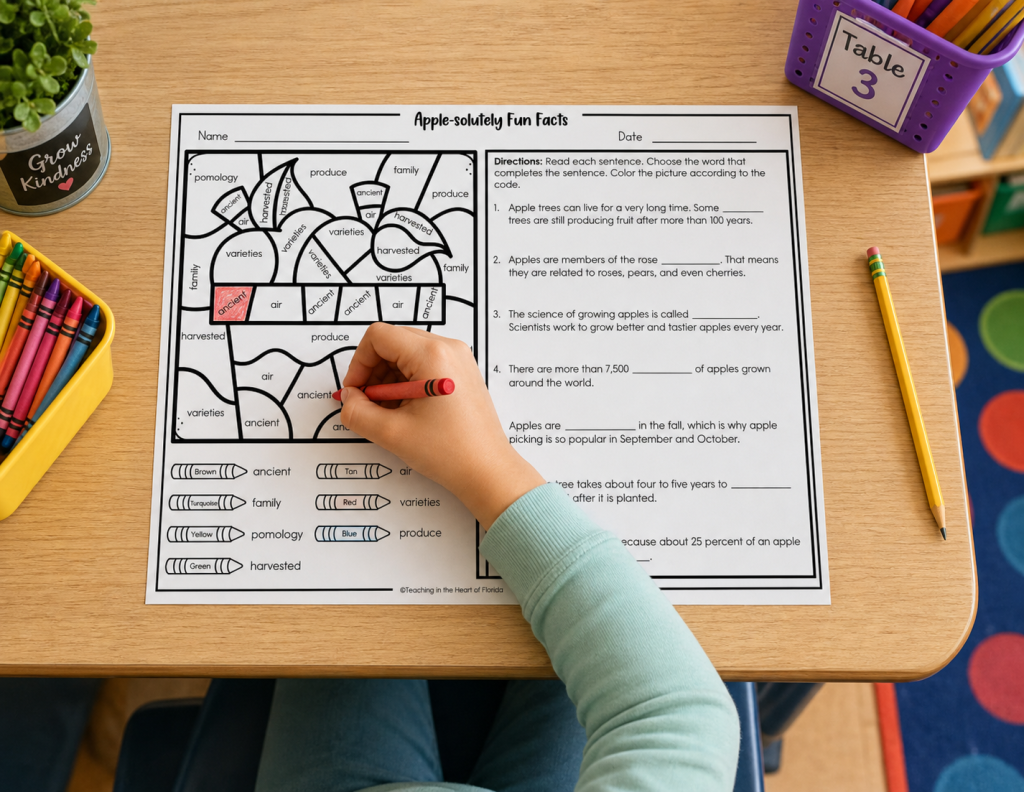
Here is something most escape room resources do not think about. What happens when one group finishes and three others are still working?
Every teacher knows this moment. A group of students cracks the code, looks up with huge smiles, and then immediately starts looking around the room for something to do. If you do not have a plan for that, things can unravel fast.
That is why every one of my reading escape rooms includes a color by number activity that students complete after they solve the mystery. Each color by number is themed to match that particular escape room, and depending on the version, it may be a vocabulary activity or simply a fun reward for solving the code. Either way, it gives early finishers something purposeful and enjoyable to do while the rest of the class is still working.
It is a small detail, but it makes a big difference on the day you actually run one of these in your classroom.
Frequently Asked Questions
Do students need to finish all four challenges to get the escape code?
Yes, and that is actually by design. Each challenge produces one number in the four-digit escape code, so students need to complete all four to crack it. This built-in accountability keeps groups from skipping ahead or giving up partway through. Every challenge has to be completed, which means every skill gets practiced.
What do I do if a group gets stuck?
Each challenge has multiple possible answers built in, so if a group is stuck it usually means they need to go back to the passage and read more carefully. That is a feature, not a bug. You can encourage stuck groups to reread the relevant section of the passage rather than stepping in with the answer. The teacher instructions page included with each escape room also walks you through each challenge so you know exactly what to expect before you hand it out.
Can I use the same reading escape room more than once with different groups?
Yes, especially if you are using it across different class periods or with different small groups throughout the day. Since all the materials are print and go, you can simply make additional copies. The escape code is the same for every group, so there is no extra prep involved in running it multiple times.
If you have been putting off trying a reading escape room the same way I did, I get it. It sounds like more work than it is. But once you see your students huddled together, arguing over whether a statement is true or false and flipping back through the passage to prove each other wrong, you will wonder why you waited so long.
Browse the by grade level here:
3rd Grade | 4th Grade | 5th Grade