





Written by Rissa Hanneken, former 3rd-5th grade teacher, instructional coach, and new teacher mentor with 19 years of experience in Florida classrooms, and the creator of Teaching in the Heart of Florida. Rissa creates no-prep reading, math, and emergency sub plan resources for upper elementary teachers, built on real classroom experience. Her resources are purposeful, manageable, and ready when you need them most.
The first week of school for 3rd grade is kind of a big deal. Your students just made the jump to upper elementary, and for a lot of them, that feels huge. New classroom, new expectations, and a teacher they are still figuring out.
You have a lot to cover. Rules. Procedures. Where to turn in work. How to ask for help. What happens when they finish early. The list goes on.
I remember standing in my 3rd grade classroom during my third year of teaching, thinking I had it all planned out. I had my anchor charts ready. I had my cute getting-to-know-you activity printed and sitting on desks. Then my students finished it in about seven minutes flat and looked up at me like, “Now what?”
That is the thing nobody warns you about. The first week of school has a lot of time to fill, and the activities most of us default to are way too short. Most activities are fun, but they do not actually help you teach your classroom expectations or give your students a real picture of how your classroom works.
So I started doing something different. Instead of another worksheet or a quick icebreaker, I created a reading escape room around the concept of rules and procedures. My 3rd graders solved clues and pieced together a mystery. The whole time, they were actually learning about classroom rules and procedures.
The quick, fun stuff still has its place. Here is how to add one activity to your first week of school that does the heavy lifting on rules and procedures while your students think they are just having fun.
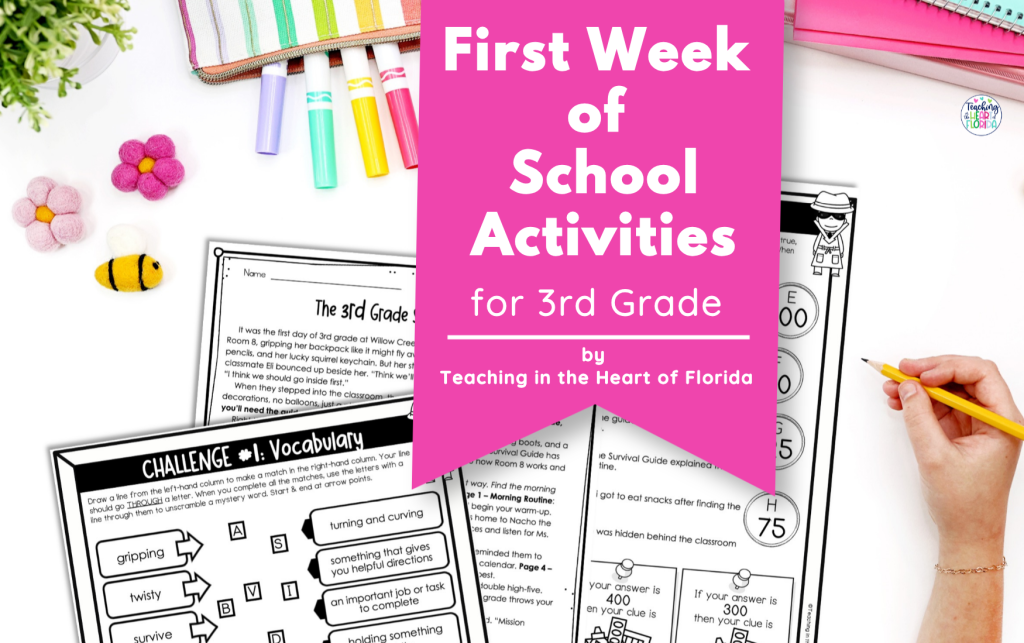
Table of Contents
What Should the First Week of School Activities for 3rd Grade Actually Look Like?
The first week of school should do three things.
- Help your students feel safe and settled. Third graders are coming in with a lot of nervous energy. Even the kids who seem confident are watching you closely to figure out what kind of classroom this is going to be.
- Give you a real chance to teach your expectations. Not just mention them once on a poster, but actually practice them. Walk through them. Give kids a reason to pay attention to them.
- Feel like your class. Not a holding pattern until the real learning starts. Third graders can tell when you are just filling time, and it sets the wrong tone.
Research backs this up, too. Edutopia outlines how the first five days of school set the tone for everything that follows, and purposeful planning during that window makes a real difference for students all year long. You can read more about that here: The First 5 Days of School
The problem is that most first week of school activities check the first box. A getting-to-know-you bingo is cute. An about me pennant is fine. But neither one teaches your students how to work in your classroom, nor does it provide you with useful information about how your kids think, collaborate, or handle a challenge.
That is where the escape room comes in.
Why an Escape Room Works So Well for the First Week of School
I know what you are thinking. An escape room sounds like something you do after state testing, not during the first week of school. But hear me out.
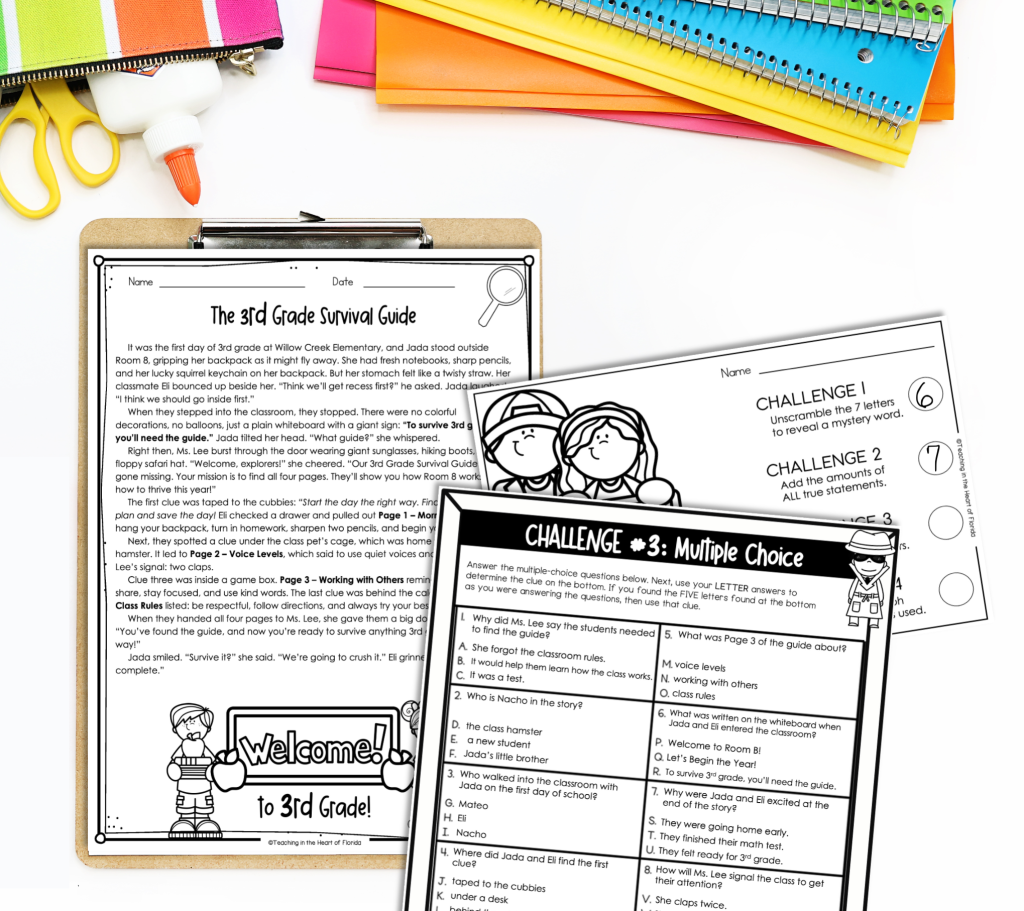
An escape room for the first week of school is not the same as a themed Halloween escape room or a math review escape room. This one is built around classroom rules and procedures, delivered through a fictional story your students will actually want to read. They are reading, thinking, collaborating, and problem-solving during the first week of school, which tells you a lot about your class right away.
Because it is structured as a mystery with a clear goal, your students are locked in. Not because you told them to pay attention. Because they actually want to figure it out.
For 3rd graders specifically, this format works really well. They are old enough to handle the challenge but still young enough that the novelty of a classroom mystery feels genuinely exciting. You will start learning who your kids are right away. Some will surprise you by taking charge. Others will slow down and focus in a way you would not expect on day three of school.
It is one of those activities that looks like pure fun from the outside but is doing a lot of real work underneath.
How the 3rd Grade Survival Guide Escape Room Works
Let me walk you through exactly what this looks like so you can picture it before you even print the first page.
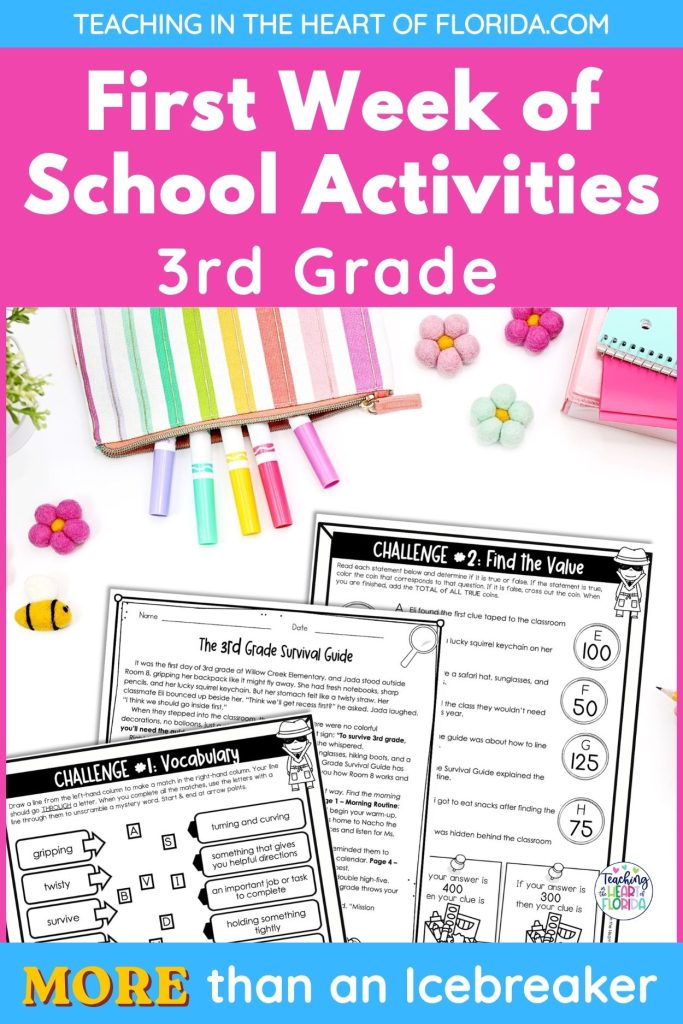
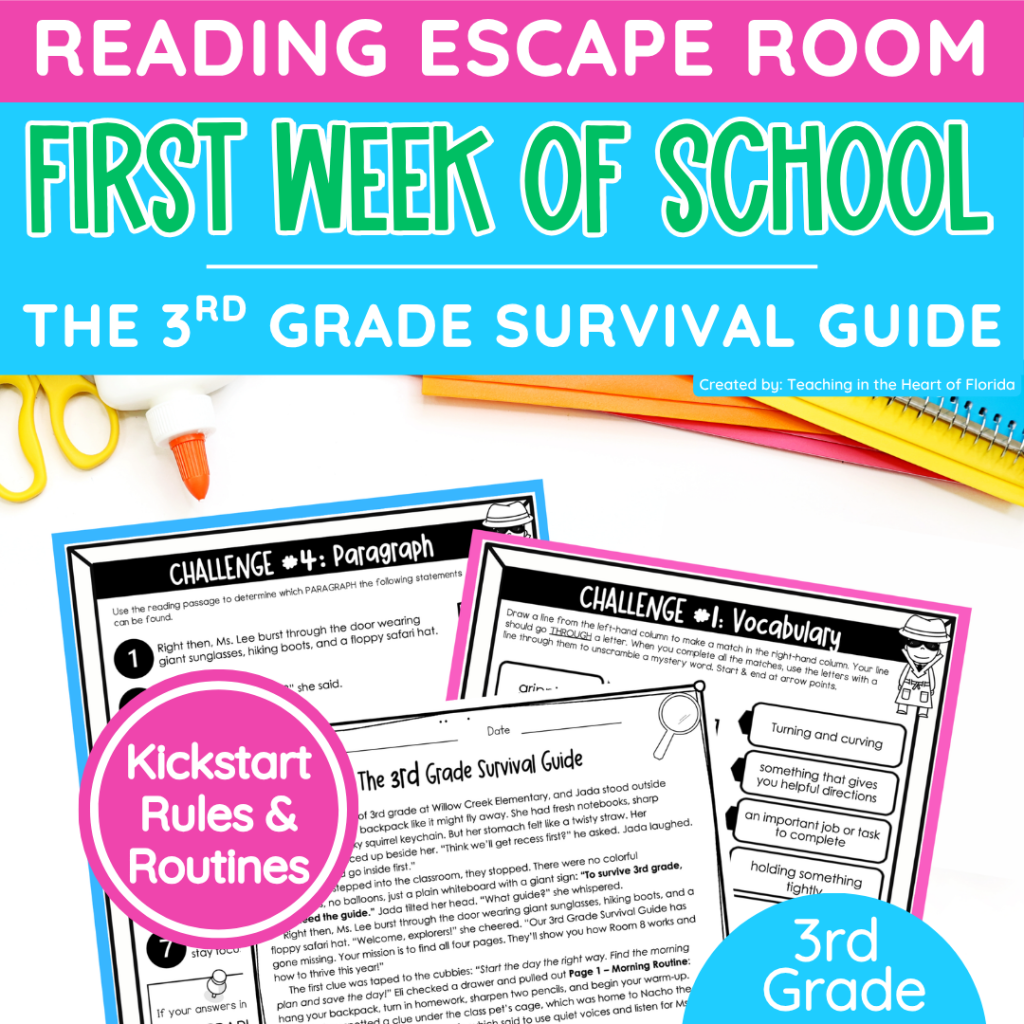
Your students start by reading a short fictional story called “The 3rd Grade Survival Guide.” In the story, two students, Jada and Eli, arrive on the first day of 3rd grade to find their classroom stripped bare. No decorations, no balloons, just a whiteboard with a mysterious message: “To survive 3rd grade, you’ll need the guide.” Their teacher, Ms. Lee, bursts through the door in a safari hat and sunglasses, announcing that the Survival Guide has gone missing. The mission is to find it.
Here is the part that makes this more than just a fun story. As Jada and Eli hunt for the missing pages, they discover the four sections of the guide: the morning routine, voice levels, working with others, and class rules. Your students are reading about fictional classroom expectations that mirror real ones. By the time they finish the story, they have already been introduced to the kinds of procedures you will be teaching all year.
Then the challenges begin.
There are four of them, and each one earns students a number that becomes part of the final escape code.
Challenge 1 – Vocabulary
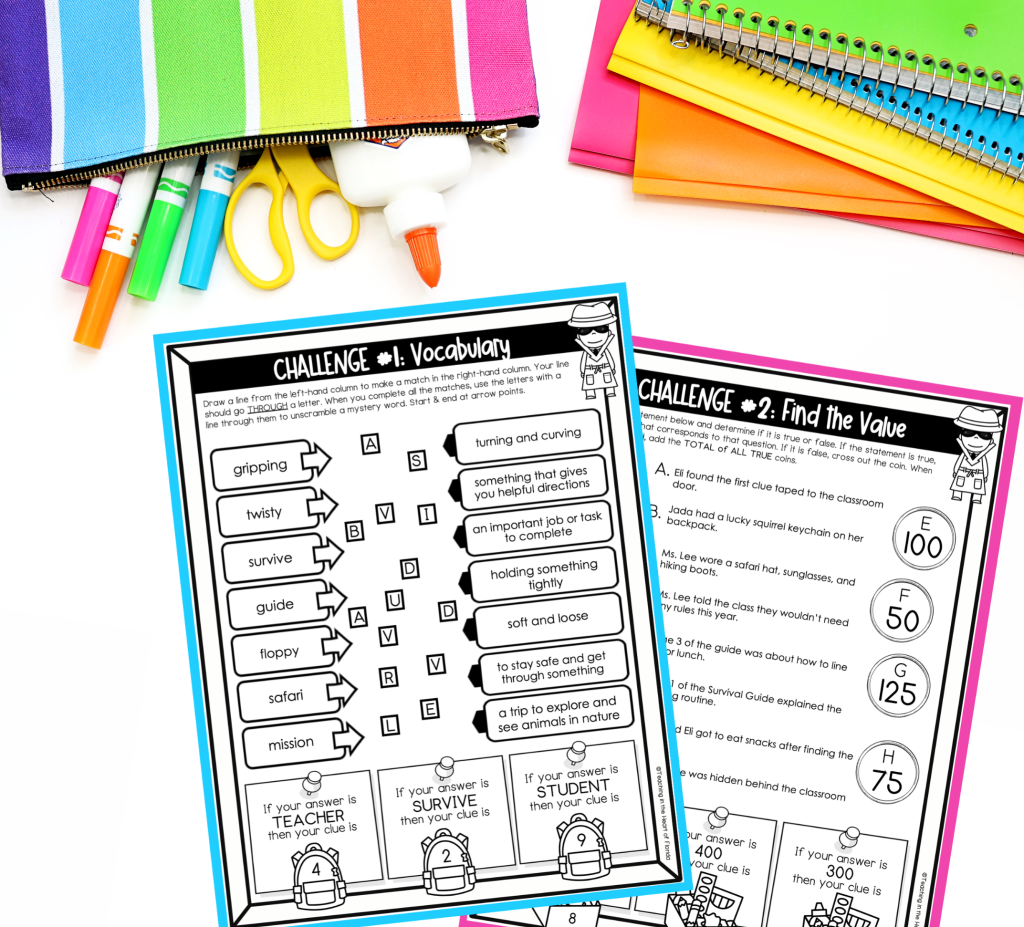
Challenge 1 is a vocabulary matching activity. Students draw lines to match words from the story to their definitions. The lines pass through letters, and when students unscramble those letters, they reveal a mystery word that gives them the first number in the code.
Challenge 2 – True or False
Challenge 2 is a true or false activity. Students read statements about the story and decide if each one is true or false. They color the coins that match true statements and add up their values to get the second number.
Challenge 3 – Multiple Choice
Challenge 3 is multiple-choice comprehension. Students answer eight questions about the passage and use their letter answers to identify the third number.
Challenge 4 – Identify the Paragraph
Challenge 4 asks students to return to the passage and identify which paragraph each statement came from. Their answers point them to the fourth and final number.
When all four challenges are complete, students combine their numbers into a four-digit escape code. If they cracked it correctly, they have escaped. There is also an optional color-by-number prize page that students can complete once they finish, which is a nice reward for groups that get there early, while others are still working.
You can run this escape room as a whole class, with partners, or in small groups, whichever works best for your class. How you structure it will also affect how long the activity takes. A whole-class experience might move faster with more discussion built in, while small groups tend to slow down in the best possible way as students debate answers and check each other’s thinking. Either way, you set it up once, print and go, and your students are doing real reading and thinking work during the first week of school.
What Happened When I Tried This During the First Week of School
The first time I used this with my class, I was a little nervous. It was the first week of school, and I was handing my brand-new students a challenge activity before we had really settled into any routines yet.
That nervousness disappeared pretty fast.
Within about five minutes, every single group was heads down and working. I heard kids reading clues out loud to each other. I heard them disagreeing, talking it out, and changing their answers. I saw a girl in the back corner who had barely said a word all morning become the one urging everyone to go back into the story for the answers.
The rules-and-procedures piece worked exactly as I hoped it would. Because the story was built around how a classroom works, my students were actually learning about expectations while they were having fun. By the time we debriefed as a class, most of them could already tell me the answers without looking.
That is the thing about this activity. It does not feel like instruction to your students. But it absolutely is. I think its sort of a sneaky way to let them know you want them to go back into the text to find the answers without explicitly telling them to.
Tips for Making It Go Smoothly
A few things I learned along the way that will save you some time.
- Read through the teacher guide the night before, even if it only takes five minutes. You will feel much more confident when questions come up, and they will come up.
- Decide in advance how you want to run it. Whole class, partners, or small groups all work, but knowing your plan before students walk in makes everything run more smoothly. One option is to read the story together as a class and work through the first challenge as a group. This gives your students a chance to feel comfortable with the format before working more independently, and it gives you a chance to see how much support they might need before you send them off on their own.
- Do the debrief. It is tempting to skip it if you are running short on time, but the five-minute whole-class conversation at the end is where a lot of the learning gets locked in. Ask your students what clues were tricky, what they had to re-read, and what they now know about your classroom. You will be surprised by what they say.
Frequently Asked Questions
When should I use this during the first week of school?
Most teachers find that day two or day three is the sweet spot. Day one tends to be full of interruptions, supply drop-offs, and general chaos. Once your students know where to sit and the initial excitement has settled down a little, they are ready to dig in, and the activity lands much better.
What do I need to get started?
Just print and go. There are no locks, no elaborate props, and no special materials required. The file includes everything: the reading passage, all four challenge pages, the student recording sheet, the answer key, and the optional prize page. Most teachers tell me they had it ready in under ten minutes.
How long does it take?
That depends on how you run it, but plan for a solid chunk of time, which is exactly what you need during the first week of school. It can fit naturally into any day during the first week. Use it as the anchor for a morning block, a mid-week change of pace, or a Friday wrap-up. No scrambling for what comes next.
What if my students finish early?
There is an optional color-by-number prize page included in the file that early finishers can work on while other groups are still going. It is a low-key reward that keeps everyone busy without drawing attention away from groups that are still working.
Ready to Make Your First Week of School Unforgettable?
Your 3rd graders are walking into your classroom, ready to figure out who you are and what your class will be like. This escape room is the first week of school activity that feels exciting, builds community, and sets expectations all at once.
You put a lot of work into setting up your classroom. This is the activity that makes your first week feel just as intentional.
Grab the 3rd Grade Survival Guide Escape Room and have it ready before your students walk in the door.
More Posts You Might Like
5 First Day Classroom Procedures You Need to Teach
Not sure which procedures to tackle first? This post breaks down the five most important ones to teach on day one, including the bathroom, getting students’ attention, lining up, the 5 ft. rule, and three before me. There is also a free classroom procedures planning guide you can grab to help you map out the rest.
How to Write Classroom Procedures That Create a Safe and Respectful Place for Students and You
Once you know which procedures to teach, the next step is writing them in a way your students can actually follow. This post walks you through exactly how to do that, including how many steps are appropriate for each grade level and the questions to ask yourself as you plan.