1. Begin with the Close Reading 1st Read steps. Go over the steps so students know what
to do while reading. Make sure students have a pencil in hand.
2. Students read the Introduction page and Northeast Region text independently OR you
read while they follow along. Reading this together is a great option for the first day of this
unit. Modeling how to close read is very important, especially for struggling readers and
second language students. It can set the stage for how you want them to effectively and
efficiently read the rest of the regions text.
3. Immediately after reading, model or have students answer the question “What’s the
gist?”. This helps students begin to understand the main idea of the text.
4. Next, we want students to go back to the text for words they do not understand and list
those under Vocabulary #3. They can then go back and use context clues to help them
define those words. If you are doing this together, it is a great opportunity for you to model
how to use context clues!
5. Give students a copy of the Northeast Region map and let them use the text to label the
map and find four facts about this region.
On each of the next four days, this process is repeated except I begin to release more responsibility to my students to complete the close reading steps in pairs and then independently.

1. Students will read the Southeast Region text today – either with a partner or
independently. Have them complete the Close Reading 1st Read page for this text. As I
begin to release to my students on this day, I will require them to complete the main idea
and key details organizer as a formative assessment. I use that to see how they are doing
and decide who may need support, which I will do in small groups.
2. Students will complete labeling of the Southeast Region map and add four details found
in the text.
1. On this day, I want my students to start putting this together. I have them read the new
text on the Southwest region, but also begin answering language arts question stems
that are based on the first three texts – Northeast, Southeast, and Southwest Regions.
2. Students will continue with maps by completing the Southwest Region map.
1. After reading the Midwest text, students will have the opportunity to compare two
regions in depth by using the Compare and Contrast graphic organizer. I let them
choose which two they would like to compare.
2. Students complete the Midwest Region map. By day four, they should really be getting
good at labeling the states and finding four good details.
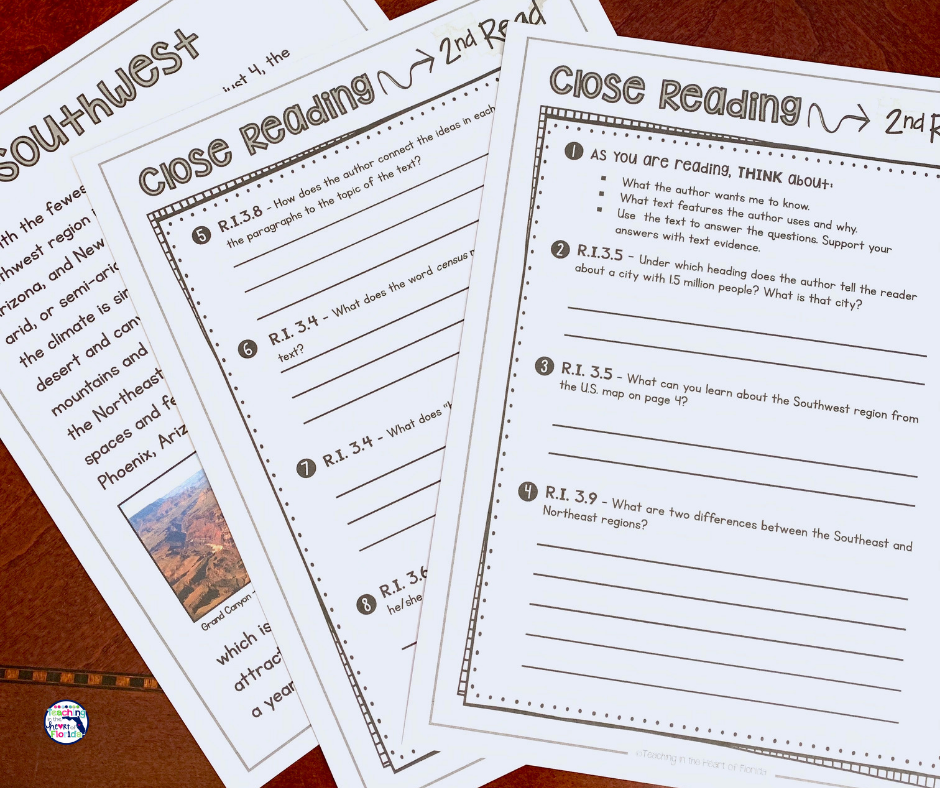
1. After reading the West Region text, students will now answer the text based questions
on page 9 of the Close Reading 2nd Read page. This page continues to challenge
students to use multiple texts to find answers and again, all of the questions are language
arts based.
2. Today, students will complete the final map for the West Region.
1. If students have been able to complete all 5 days of this lesson, I give them either the
Main Idea/Key Details to use with the entire text OR choose two regions to compare
using the Compare/Contrast Organizer. This is a good assignment to take for a grade.
2. Independently, with a partner, or in a center students will practice the vocabulary by
putting together the jigsaw vocabulary pieces.
1. As a final assessment grade, I give my students a unit test which is included in this
resource.
This time frame is easily adjusted based on your own schedule. The activities listed could be done in a variety of settings: whole group, small group, partners, independently, and in centers. This lesson is formatted as a gradual release to students, but your own class may require more or less support from you.
By the end of this unit, your students will be experts on the Regions of the United States! They have used close reading strategies to determine main idea and key details, comparing and contrasting, vocabulary, and map skills. You have given them the opportunity to access the following Common Core Language Arts standards: CCSS.ELA – Literacy. RI.3.1, 3.2, 3.4, 3.7, 3.9 and several of your state’s Social Studies standards which vary by state.
I hope you enjoy using this resource! Here’s what other teachers have said:
“These kept my students engaged during this unit. They enjoyed reading and gathering new information about our regions. It was very simple and allowed us to be able to use our close reading skills. Thank you for such a great product!” – J.W.
“This is perfect and exactly what I was looking for!” – K.G.
Not sure if this is right for your classroom? Try the Southeast Region for free!
Do you combine close reading and Social Studies topics? Leave a comment and share!
~Don’t forget to pin this post or an image so you can access this content quickly and easily!~






0 Responses
This comment has been removed by a blog administrator.