






Written by Rissa Hanneken, former 3rd-5th grade teacher, instructional coach, and new teacher mentor with 19 years of experience in Florida classrooms, and the creator of Teaching in the Heart of Florida. Rissa creates no-prep reading, math, and emergency sub plan resources for upper elementary teachers, built on real classroom experience. Her resources are purposeful, manageable, and ready when you need them most.
First week of school activities for 5th grade come with a question most teachers quietly ask themselves: Does any of this even matter anymore? By the time your students walk through the door in August, they have already done this six times. They know the drill. They have heard the rules speech. They have filled out the “About Me” sheet. They have sat through the procedures slideshow.
This year, they are the oldest kids in the building.
I taught 5th grade, but not at the start of the year. I came in mid-year, and within the first few days I realized these kids were operating on a completely different level than anything I had experienced before. The social dynamics, the way they tested boundaries, the way they masked when something was hard. It was eye-opening.
That shift changes everything. Over the summer, something clicks for most 5th graders. They realize they are at the top of the elementary food chain, and they walk in craving autonomy, testing boundaries, and hyper-aware of what their peers think of them. They are not trying to be difficult. They are just done being treated like little kids.
Which means the first week of school activities for 5th grade cannot look like the first week of school activities for 3rd grade. You are not molding eager-to-please students who will line up like quiet statues because you asked them to. You are navigating the messy, exciting early edge of adolescence, and your students are watching closely to see if you are going to treat them like the young adults they are becoming.
The good news is that 5th graders who feel respected and challenged will give you everything. The first week is your chance to earn that. Not through compliance, but through buy-in.
The quick, fun stuff still has its place. Here is how to add a first-week-of-school activity for 5th grade that meets your students exactly where they are, and gets them locked in from day one.
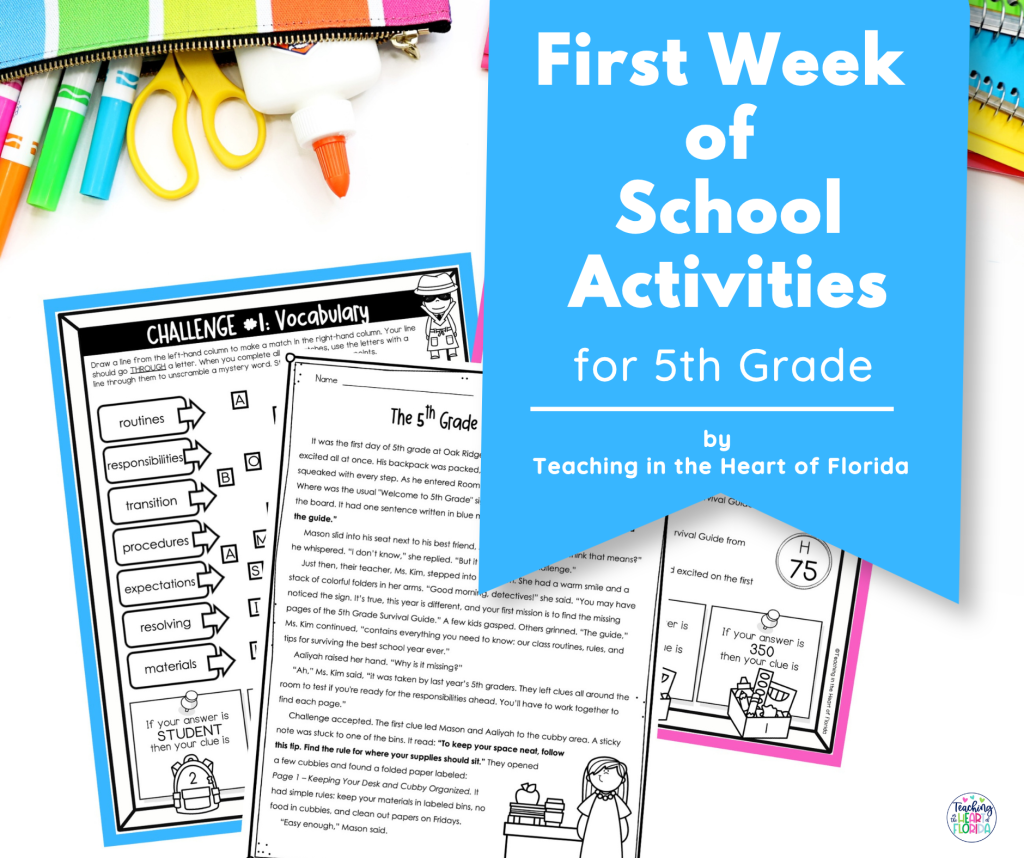
Table of Contents
Does the First Week of School Matter for 5th Grade?
The short answer is yes. More than ever.
But it has to look different.
A 3rd grade teacher can post the rules on the wall and walk through them one by one and most students will follow along because they still want your approval. A 5th grade teacher who tries that same approach on day one is going to lose the room before lunch.
Fifth graders are not defiant. They are perceptive. They walk in on the first day running a silent social calculation: is this teacher going to treat us like capable people or like babies? If your first week feels too juvenile, they will tune out. If it feels worthy of them, they will lean in.
That is the real challenge of the first week of school for 5th grade. You are not just teaching procedures. You are building buy-in with students who can smell inauthenticity from a mile away.

The first week should do three things specifically for 5th grade.
- Establish mutual respect early. Fifth graders respond to teachers who pitch the why behind the rules, not just the what. When students understand that your procedures exist to make their year run smoothly and give them more independence, not less, they are far more likely to follow them.
- Give them a real challenge. Fifth graders who feel bored or patronized will find other ways to entertain themselves. An activity that treats them as capable thinkers sends a message about what kind of year this is going to be before you have said a single word about expectations.
- Help you see who they really are. Fifth graders are experts at masking. The student who looks bored might be anxious. The one cracking jokes might be covering up a reading gap. The first week is your best window to look past the social performance and start to see who is actually in the room.
Research backs this up. Edutopia makes the case that the first five days of school set the tone for the entire year, and that intentional planning during that window pays dividends all year long. For 5th grade especially, that intentionality is not optional. You can read more here: The First 5 Days of School
Most first week of school activities for 5th grade are designed for a younger version of your students. They are cute, they fill time, and they do not ask much of anyone. That is exactly the problem.
That is where the escape room comes in.
Why an Escape Room Works So Well as a First Week of School Activity for 5th Grade
Fifth graders do not want to be managed. They want to be challenged.
An escape room built around classroom expectations is one of the best first week of school activities for 5th grade because it speaks directly to what this age group responds to. It is a mystery. It has a mission. It has a code to crack. It frames the whole experience around the idea that 5th grade comes with new responsibilities and new expectations because they are the leaders of the school now.
That framing matters more than you might think.
When Ms. Kim walks into the classroom in the story and calls her students “detectives,” she is not asking them to follow rules. She is inviting them into a challenge. She tells them the Survival Guide was taken by last year’s 5th graders, who left clues around the room to test whether they are ready for the responsibilities ahead. Your students have to work together to find it.
That is a completely different energy than a procedures slideshow.
Because the mission is framed around responsibility and readiness rather than compliance, your 5th graders are not rolling their eyes at the rules. They are invested in finding them. The four pages of the guide cover keeping their desk and cubby organized, transition procedures including the Freeze and Focus signal, partner and group work expectations, and classroom rules. All of it lands in the context of becoming the kind of student who is ready for what comes next.
Meanwhile, you are watching.
- Who takes the lead?
- Who goes quiet when things get challenging?
- Who uses humor to deflect when they are not sure of an answer?
This is some of the most useful information you will collect all year, and you are getting it on day two or three before you have even opened your grade book.
The story ends with Aaliyah saying, “Fifth grade is going to be different. But I think we’ve got this.” That is exactly the tone you want to set in the first week. Not compliance. Confidence.
How the 5th Grade Survival Guide Escape Room Works
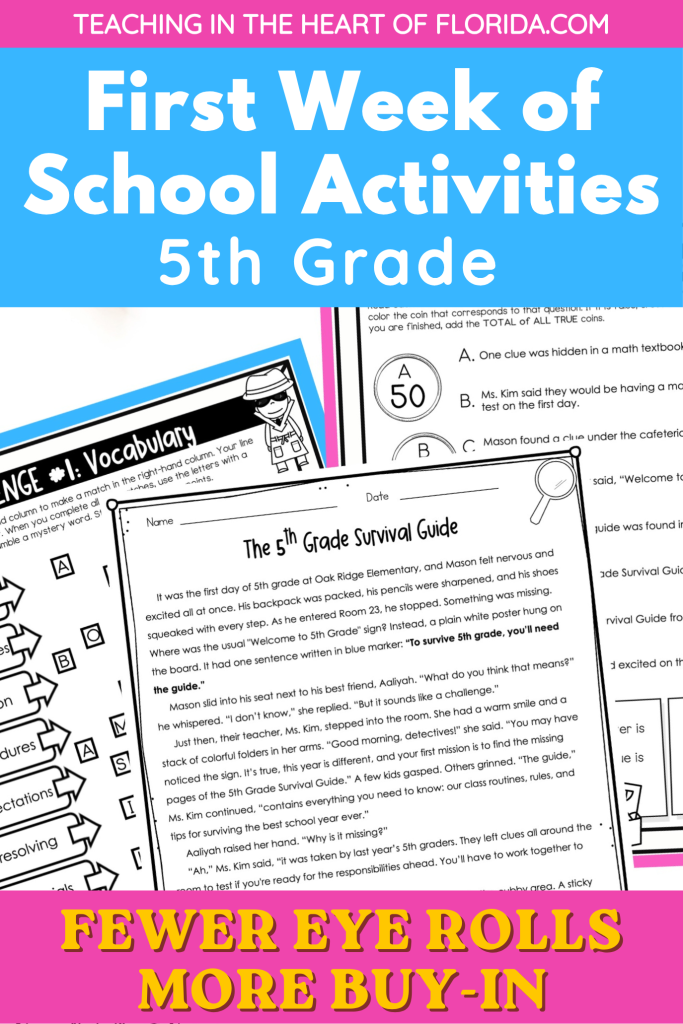
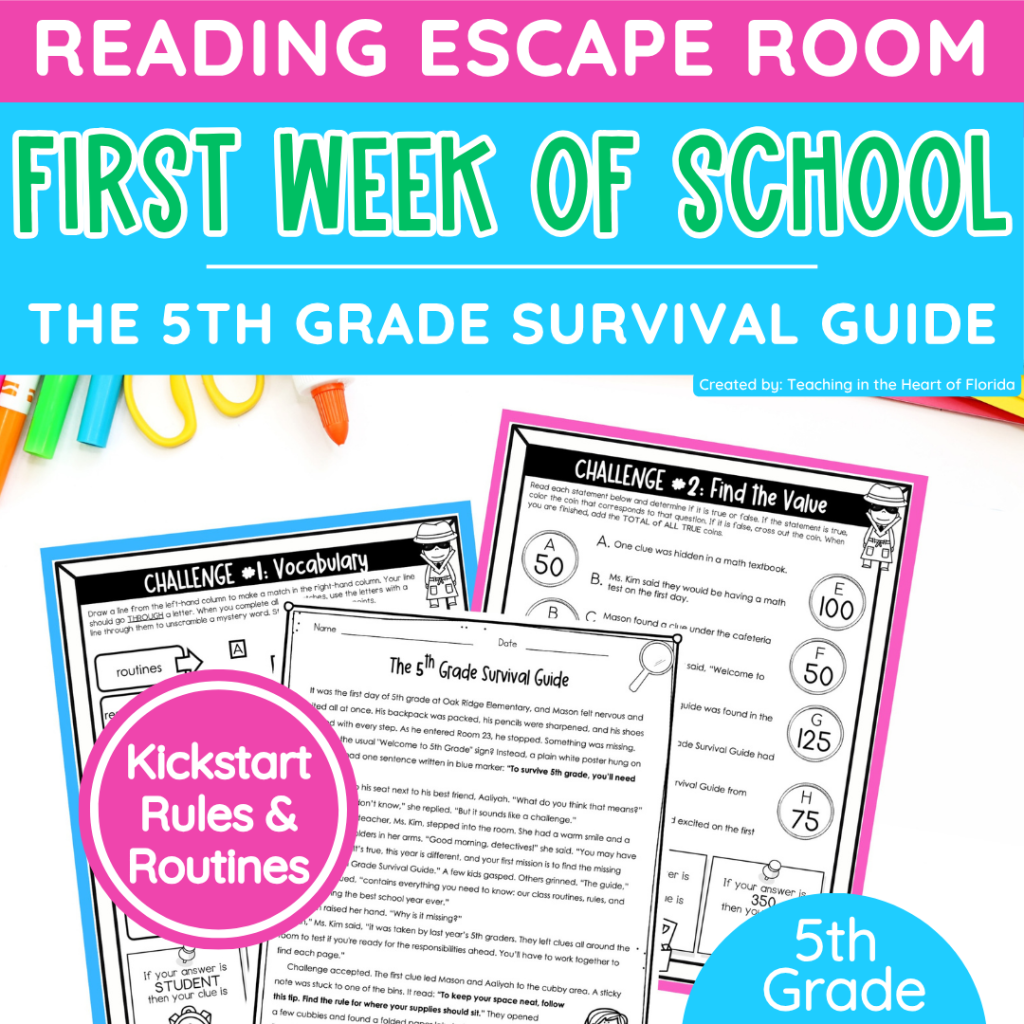
Your students start by reading a short fictional story called The 5th Grade Survival Guide. The story introduces Mason and his friend Aaliyah on the first day of 5th grade. Their teacher, Ms. Kim, greets them as detectives and tells them the Survival Guide has gone missing. Their mission is to find it.
Then the challenges begin.
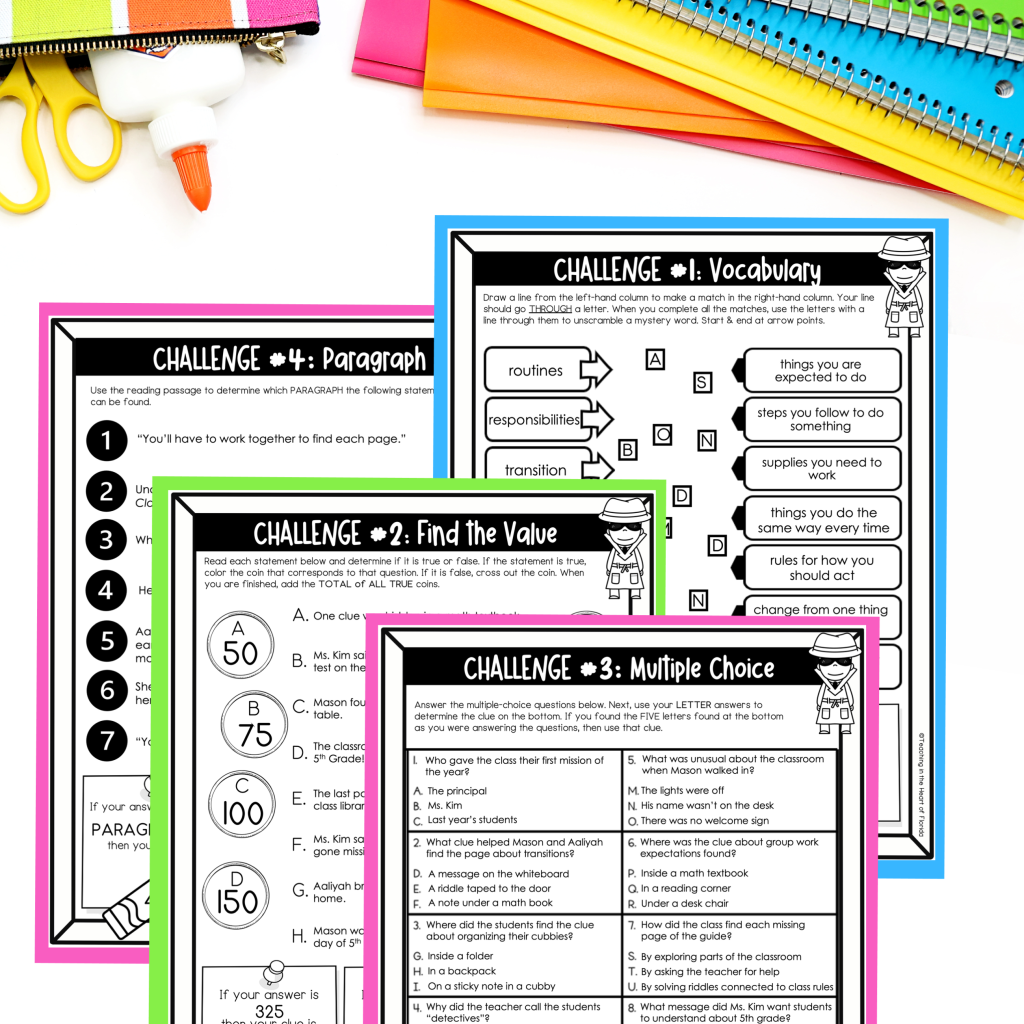
There are four of them, and each one earns students a number that becomes part of the final escape code. Here is what makes this escape room different from a typical first week activity: your students will go back into that story over and over again. Not because you told them to. Because the challenges require it.
Challenge 1: Vocabulary
Students match seven vocabulary words from the story to their definitions, including words like responsibilities, resolving, and transition. Figuring out the right match means going back into the story to see how each word was used in context. That is close reading happening on day two of the school year.
Challenge 2: True or False
Students read statements about the story and decide if each one is true or false. Several statements are designed to trip up students who are going on memory alone. To get the right answer, they have to go back and verify.
Challenge 3: Multiple Choice
Students answer eight comprehension questions and use their letter answers to identify the third number. Several questions ask students to think beyond the surface of the story, which means even confident readers will find themselves flipping back to double-check.
Challenge 4: Identify the Paragraph
Students identify which paragraph each statement came from. They cannot guess their way through this one. They have to locate specific information precisely, which is exactly the kind of close reading skill that matters all year.
By the time your students have worked through all four challenges, they have read and re-read that passage more times than they realize. That is purposeful reading practice wrapped inside a mystery, and it does not feel like work.
Meanwhile, you are getting something valuable too. As your students work, you can take anecdotal notes.
- Who reads carefully and goes back to check?
- Who guesses and moves on?
- Who shuts down when the answer is not obvious?
- Who finishes fast?
In the first week of school, before any formal assessment has happened, this escape room gives you a real window into how your students approach a challenge. For 5th grade especially, where students have learned to mask their struggles behind confidence or apathy, that informal read on your class is worth more than you might expect.
You can run this escape room as a whole class, with partners, or in small groups, whichever works best for your class. For 5th grade specifically, small groups or partners tend to work especially well because the collaborative dynamic is part of what you are trying to observe and build during the first week of school. Either way, you set it up once, print and go, and your students are doing real reading and thinking work from day one.
Tips for Making It Go Smoothly
A few things that will help you get the most out of this first week of school activity with your 5th graders.
- Read through the teacher guide the night before. You will feel much more confident when questions come up, and they will come up.
- Think carefully about how you group your students. For 5th grade, grouping decisions carry more weight than they do in younger grades. The social dynamics that walk through your door on day one are real, and a mismatched group can shut a student down before the activity even starts. If you have any information about your class coming in, use it.
- Frame it the right way when you introduce it. Do not oversell it and do not undersell it. Tell your students they are detectives with a mission and that 5th grade comes with new responsibilities. Let the story do the rest. Fifth graders respond to being treated as capable, and this activity is built for that.
- Let it run. Fifth graders who are genuinely engaged do not need much from you once they get started. Resist the urge to over-manage the activity. Step back, circulate, and observe. That is where the value is for you as their teacher.
- Do the debrief. For 5th grade, the debrief is where the real gold is. Ask your students what the story taught them about how a classroom runs. Ask them what surprised them. Ask them what responsibilities they think come with being the oldest students in the building. You are setting the tone for the kind of conversations your class will have all year.
Frequently Asked Questions
When during the first week of school should I use this?
Day two or day three tends to work best. Day one has a lot of moving parts, new faces, and general first-day energy. By day two, your students are settled enough to focus, and the activity lands with much more impact when they are not still figuring out where the bathroom is.
How long does it take?
That depends on how you run it, but plan for a solid block of time. Fifth graders who are engaged will take their time going back into the text and debating answers, which is exactly what you want. Small groups tend to run a little longer than a whole class experience, but the extra time is worth it for what you learn about your students in the process. Since it is the first week of school and your schedule has a little more flexibility than it will later in the year, you could also plan to split it across two sessions. Read the story and complete the first couple of challenges one day, then finish the remaining challenges and do the debrief the next. That gives you two built-in observation windows instead of one.
What if students finish early?
The prize pages for 5th grade are a step up from a simple color-by-number. Early finishers receive a sentence-completion puzzle and a vocabulary riddle activity, both built around the story. It is a reward that still feels worthy of a 5th grader and keeps everyone productively busy while other groups finish up.
Ready to Start Your First Week of School on the Right Foot?
Your 5th graders are walking through the door ready to figure out if this year is going to be different. They want to be challenged. They want to be respected. They want a teacher who treats them like the young adults they are becoming.
This escape room gives you a first week of school activity for 5th grade that meets them exactly where they are. It builds the kind of buy-in that compliance never could. It gives you a real window into who your students are before any formal assessment begins, and it sets the tone for the kind of classroom you are building together.
You put a lot of work into setting up your classroom. This is the activity that makes your first week feel just as intentional.

More Posts You Might Like
5 First Day Classroom Procedures You Need to Teach
Not sure which procedures to tackle first? This post breaks down the five most important ones to teach on day one, including the bathroom, getting students’ attention, lining up, the 5 ft. rule, and three before me. There is also a free classroom procedures planning guide you can grab to help you map out the rest.
How to Write Classroom Procedures That Create a Safe and Respectful Place for Students and You
Once you know which procedures to teach, the next step is writing them in a way your students can actually follow. This post walks you through exactly how to do that, including how many steps are appropriate for each grade level and the questions to ask yourself as you plan.